From Amish to a Business Where Drones Do All the Work
In this fascinating episode, we explore the remarkable journey of Mike, who transitioned from living a traditional Amish horse and buggy lifestyle to becoming a multi-million dollar business owner in the drone industry. Starting just four years ago, Mike revolutionized drone deer recovery and expanded into agricultural drone spraying, creating a thriving business ecosystem with automated drone technology.
The Amish to Entrepreneur Journey
Breaking Away from Tradition
Mike shared how, at about 16 and a half years old, he realized he didn't want to continue living the Amish lifestyle. He said:
"I was like, I am not driving a horse and buggy to work. I am not dressing that way."
His parents struggled with the decision but did not shun him. Mike now lives on his family farm, maintaining good relations despite choosing a different path.
When Mike started dating his now-wife, who was not Amish, he came to the conclusion:
"I learned that I don't have to be Amish to get to heaven."
This conviction led him to leave the Amish lifestyle while still keeping peace with his family and community.
The Birth of Drone Deer Recovery
How It Started
Mike’s drone journey began with a simple experiment-buying a DJI Dual drone (with thermal and zoom cameras) to film deer on his property. He brought the video to a local outdoor show with a makeshift booth: a table, an old iMac, and a looping thermal video of deer on the screen. Despite its simplicity, the booth attracted huge attention.
- People were fascinated by the thermal-zoom combination showing heat signatures that identified deer.
- The show coordinator asked Mike to move his booth because it was blocking traffic due to crowds.
This success gave Mike confidence to pursue the idea as a service and a YouTube channel.
"I thought originally I’d make more from YouTube ad revenue than service, but that quickly changed."
Pricing and Market Feedback
At the outdoor show, Mike considered pricing his service at $250–$350. However, hunters told him this was too low compared to alternatives like hiring tracking dogs, which cost around $350 and could sometimes fail to find the deer.
Mike adjusted his pricing to:
- $550 if the deer was successfully found
- $450 if the deer was not found
Hunters were willing to pay a premium since the drone service was often more effective than dogs and avoided disturbing other deer.
Legal Considerations
At first, drone use for deer recovery was a gray area in Ohio. Mike reached out to the Ohio Department of Natural Resources, whose head indicated there was no problem as long as drones were not used to find and then shoot deer.
Mike proactively met with local game wardens to demonstrate the technology and assure them the service was ethical. Over time, hunting regulations evolved to explicitly allow drones for deer recovery.
Growth and Scale
- Mike was the first to popularize drone deer recovery in Ohio, although others had operated quietly elsewhere.
- His first deer season resulted in $50,000 revenue in 10 weeks.
- He built a pilot locator map for customers to find drone operators near them.
- Now over 200–300 pilots are listed, paying $500/year subscriptions.
- The website drives hundreds of thousands of monthly visitors during hunting season and millions of social media views.
- The network effect strengthens the industry, making it difficult for competitors to overcome Mike’s market position.
"I’m now one of the largest distributors of thermal drones in the US."
Expanding to Agricultural Drone Spraying
How the Idea Evolved
Mike’s business grew far beyond deer recovery. Spray drones for agriculture became the dominant revenue source, with a booming market.
- Last year, the business generated over $32 million revenue.
- Profit margins on spraying can reach 70%–90%, with operating costs $3–$3.74 per acre.
- Pricing typically ranges $10–$20 per acre depending on terrain complexity.
- Typical farm sizes in Mike’s area are approx. 100 acres; some clients like onion farmers get weekly sprays during the growing season.
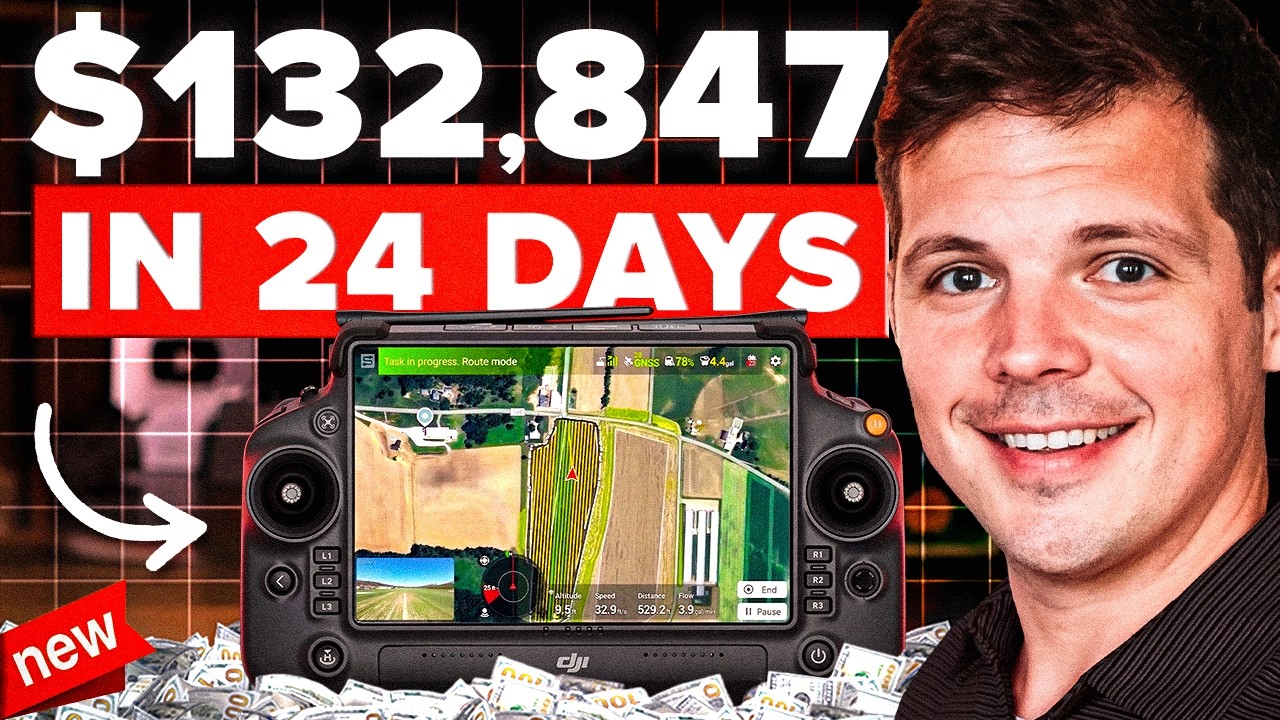
“I made $132,000 in 24 days running my spray drone. We profited $65,000 in 8 days on another job.”
Key Crops Sprayed
- Corn
- Soybeans
- Pasture land
- Pecan trees
- Almond trees
- Blueberries
- Cranberries
- Cotton (sprayed weekly until harvest)
Advantages Over Traditional Methods
- Drones can reach rugged or wooded acreage inaccessible to ground rigs or airplanes.
- Better precision and consistent altitude compared to airplanes that can miss areas near power lines or obstacles.
- Ability to spray in wet or muddy conditions, where heavy tractors cannot operate.
Customer Acquisition
Success in drone spraying relies on demonstrations:
- Entrepreneurs take equipment directly to farms.
- They perform live drone spraying demos with water to show precision and efficacy.
- Flyers and brochures are also distributed at local co-ops, rifle ranges, and outdoor stores.
- Word-of-mouth is powerful once farmers see the technology working.
“Showing the product physically to farmers is the best way to close the deal.”
Business Operations and Automation
Drone Piloting
- Drone spray missions are fully automated.
- Operators program flight paths and manage multiple drones as air traffic controllers.
- Drones take off, spray, return when fluid or battery runs low, and the operator refills and swaps batteries.
- Battery swaps occur every 4–6 minutes with 8–9 minutes charging times, maintaining continuous operation.
Licensing and Training
To start a commercial spray drone business, operators need:
- Remote Pilot’s License (Part 107) – achievable with 3 days of study and testing.
- Commercial Pesticide Applicator License – varies by state; some available online.
- An FAA Section 137 certificate to spray poisons from the air, which can take 3–4 months. Mike’s team offers a 137 Fastpass program allowing operators to fly under their license while waiting for approval.
Market Potential and Scale
The U.S. has:
- 99 million corn acres
- 82 million soybean acres
- 46 million weed acres
- 52 million pasture acres
- 11 million cotton acres
Only about 2.5% of this market is currently tapped by drones.
The industry has 94–97% untapped potential.
Sales range from backyard entrepreneurs to large operations with 10+ trailers covering 60,000 acres or more.
One large operator in Kansas with 10 trailers sprays roughly 60,000 acres per season, potentially making $600,000 per season at $10 per acre.
Challenges to Scaling
- Newness of the technology
- Customer acquisition being labor-intensive
- High ticket prices but limited by seasonality (spraying concentrated to a short part of the year)
- Regulatory hurdles for heavier drones (>55 pounds)
Unique Business Ecosystem
Mike's company combines:
- Drone deer recovery service
- Custom operator directory and lead generation platform (like the "Yelp" for deer recovery)
- Retail and distribution of thermal drones and spray rigs
- YouTube and social media content marketing driving brand and industry growth
Personal Insights and Lifestyle
Work-Life Balance
Mike emphasizes the importance of family and setting non-negotiable boundaries:
- No work during dinner or Sundays.
- Uses “Profit First” financial management principles.
- Phone on Do Not Disturb most of the time to maintain focus.
- Acknowledges seasonal bursts of intense work and compensates with downtime.
The “Testosterone Factor”
Drone spraying is a highly "testosterone" business-men are drawn by the “wow factor” of drones flying over crops, contributing to easier sales despite higher prices.
“Farmers sometimes pick the drone service over cheaper alternatives simply because it’s cool technology.”
The Future of Drone Agriculture
- Broad geographic expansion is possible, especially in Midwest farming states: Iowa, Illinois, Indiana, Missouri, Kentucky, Tennessee.
- Some areas in the West still have regulatory barriers but are expected to grow.
- Opportunities abound for former military and entrepreneurial individuals looking for outdoor, tech-driven businesses.
- The combination of automated drones, growing agricultural demand, and minimal industry penetration promises significant growth and innovation.
Final Notes
- Mike continues to reinvest in his business rather than cashing out, despite interest from private equity.
- He remains humble about his success and stresses the difficulty and complexity of fulfillment businesses like his.
- His story reflects a powerful example of entrepreneurship blending traditional skills and modern technology.
Where to Find Mike and His Business
- Drone Deer Recovery: Available on Instagram, TikTok, Facebook, YouTube
- New Way Agriculture: Social platforms under NUWAYAG
- Website: drone-deer-recovery.com for pilot locator and service information.
This conversation offers deep insights into building a drone-based business from scratch, harnessing new technology for niche markets, and transforming a legacy lifestyle into a multimillion-dollar venture. Whether you're intrigued by deer recovery drones or agricultural spraying, Mike's story is proof that motivation, innovation, and persistence can create groundbreaking opportunities.